Introduction
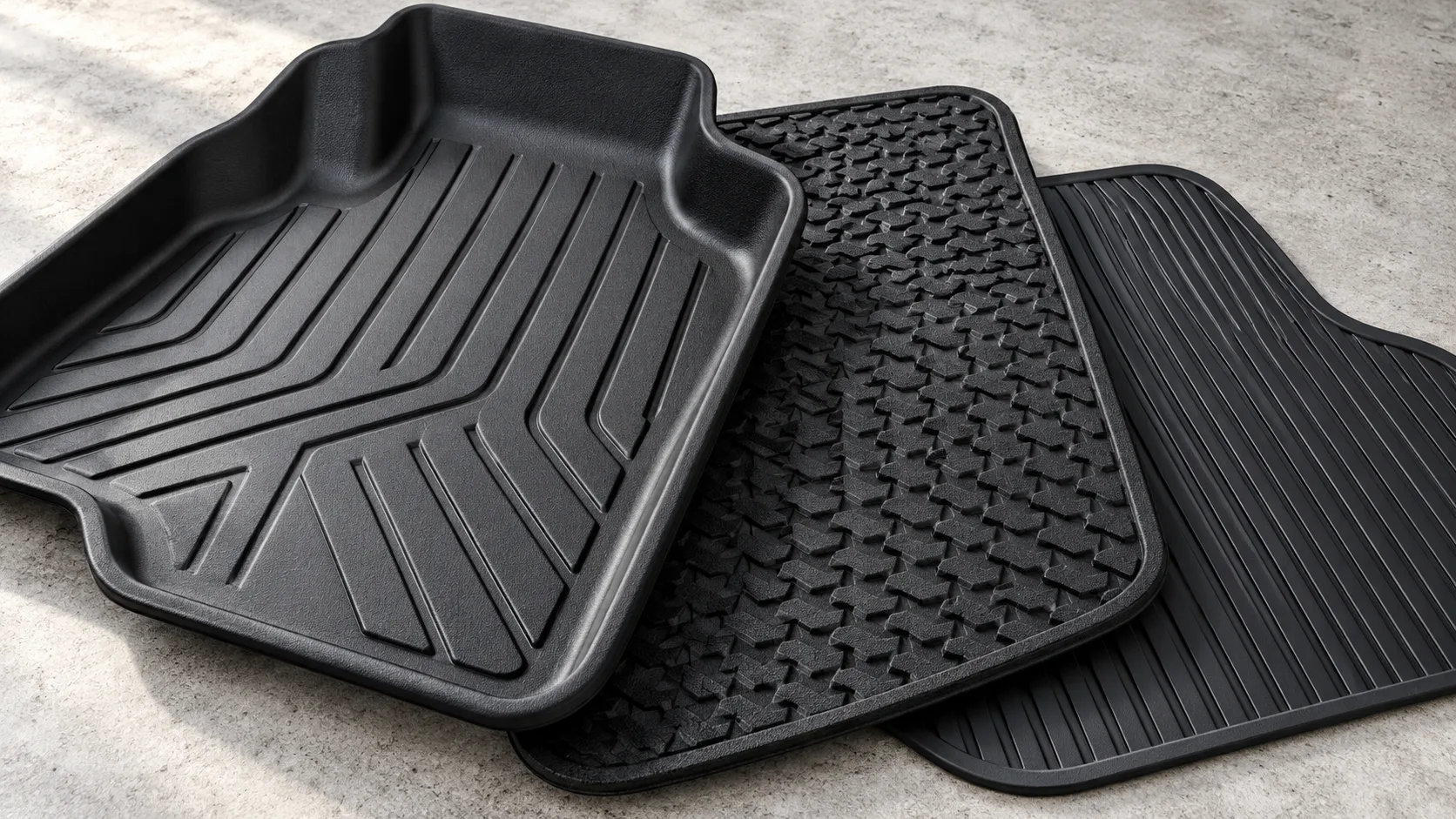
When a distributor asks whether TPE is “better” than rubber or PVC, the useful answer is rarely a one-word verdict. A floor mat has to fit a particular vehicle, remain in place, clean easily, suit the market's climate, arrive in acceptable packaging, and sell at a viable landed cost. Its material contributes to those outcomes, but the compound, geometry, production method, and quality controls matter just as much as the material label.
This guide compares thermoplastic elastomer (TPE), rubber, and flexible PVC from a wholesale buyer's perspective. It explains what to request from a supplier, how to review a physical sample, and how to avoid translating a broad material claim into an unsupported product promise. It is intended for importers, aftermarket brands, purchasing teams, and OEM/ODM project managers choosing a floor mat line rather than for drivers looking for one retail set.
Quick answer: TPE is a useful candidate for vehicle-specific molded liners when shape detail and a flexible feel matter. Rubber can be appropriate for robust, grip-oriented designs, while PVC can serve price-sensitive or construction-specific programs. None is automatically the best choice. Compare finished samples in the intended vehicle and request grade-specific evidence for odor, dimensional stability, wear, and market requirements.
Start with the product requirement, not the material name
“TPE” refers to a family of compounds, not one fixed recipe. The same is true of “rubber,” which may describe different elastomers or blends. Flexible PVC also changes with formulation, plasticizers, fillers, and processing. A catalog phrase such as “premium TPE” does not tell a buyer the exact composition or how the finished mat will behave.
Write a brief around the job the mat must do. Is the target a molded front-and-rear set for a specific SUV, a commercial fleet mat, or an entry-level universal product? Must the liner cover a high footrest, clear a sliding seat rail, work with original retention posts, or be sold in a compact retail carton? Which country, vehicle version, climate, retail channel, and price tier are involved? These questions determine the comparison criteria.
Ask the supplier to identify the material grade or approved specification for the offered SKU. If the formulation is proprietary, request the properties and documents needed to qualify it. A supplier may protect its recipe while still giving a buyer a test report, material declaration, sample identifier, and change-control process.
How the three material families differ
TPE: moldable flexibility with grade-dependent properties
Thermoplastic elastomers combine rubber-like flexibility with thermoplastic processing. Depending on the grade, they can be molded or formed into a shaped floor liner with raised edges and channels. Material makers publish TPE grades with substantially different hardness, flow, and application properties; that range is why a generic TPE label cannot establish performance. Teknor Apex's TPE overview explains the family and its processing options.
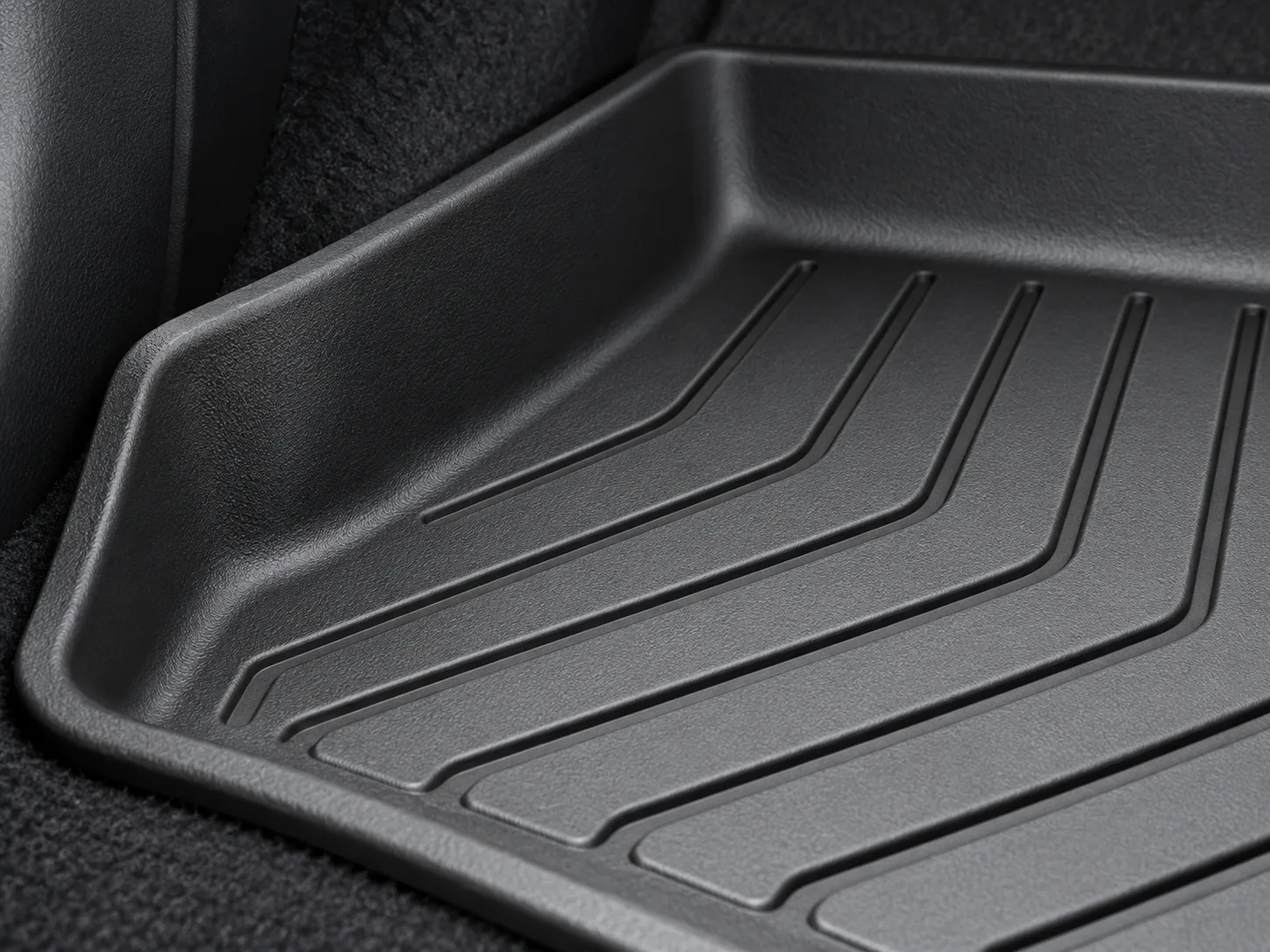
For a vehicle-specific liner, TPE's design potential is useful when a mold needs to reproduce a contoured footwell, drainage pattern, heel area, or lip. That potential does not prove the resulting product fits the vehicle. Mold design, shrinkage allowance, trimming, part conditioning, and retention features still need inspection. A sample that looks precise on a table can touch a pedal, lift around a console, or interfere with a seat track in the vehicle.
TPE is often described as recyclable because thermoplastic material can be remelted and reprocessed. That does not mean every finished mat will be accepted by a local recycling system. Multi-material construction, additives, contamination, collection infrastructure, and the destination market determine the actual end-of-life route. Request evidence before using “recycled content,” “recyclable,” or low-emissions claims in retail copy.
For the type of molded product discussed here, see HZHZMOLD's TPE floor mat overview. Its pictured features are a starting point for inquiry; the exact grade and vehicle fitment still require confirmation.
Rubber: a broad category with useful resilience
Vulcanized rubber is an established choice for mats that prioritize a flexible, substantial feel. Its performance depends on the elastomer, fillers, cure, surface design, and thickness. A rubber mat can be well suited to a fleet or utility range, but “rubber” alone does not guarantee low odor, high abrasion resistance, or a particular temperature range.
Compare the finished mat's weight, edge shape, water-holding geometry, grip, and cleaning behavior. A heavier sample may feel robust but increase shipping cost; a thick section may still curl if its construction or storage method is poor. If a supplier compares rubber with TPE, ask for test results under equivalent conditions and for samples at comparable coverage and thickness. A thin universal rubber mat and a deep custom-fit TPE tray solve different jobs, so a simple material ranking would mislead buyers.
PVC: cost options with formulation questions
Flexible PVC can be made into floor mat products at different price points and in different constructions. The finished properties depend on the resin, plasticizer system, fillers, reinforcement if any, and processing. The key purchasing task is to qualify the specific formulation for the target market and use, including any restricted-substance requirements imposed by the buyer or jurisdiction.
Do not assume every PVC product has a particular smell, stiffness, or wear life. Compare its actual sample and documentation. If a supplier proposes PVC because of a lower ex-factory price, calculate the full result: expected return rate, packaging volume, weight, retail positioning, and any compliance testing. The lowest unit price may not produce the lowest cost per saleable set.
A practical comparison matrix for sourcing
| Question | TPE program | Rubber program | Flexible PVC program |
|---|---|---|---|
| Shape and coverage | Can support detailed molded vehicle-specific designs; verify tool and installed fit | Depends on mold and formulation; inspect edge coverage and retention | Depends on construction; inspect contours and trimming |
| Flexibility | Grade and geometry dependent | Compound and cure dependent | Formulation and plasticizer dependent |
| Odor | Request a finished-part test or agreed assessment | Request the same | Request the same |
| Wear and cleaning | Test finished texture, grooves, and heel area | Test finished surface and weight | Test finished surface and plasticizer-related requirements |
| Weather suitability | Require grade-specific hot and cold data | Require compound-specific hot and cold data | Require formulation-specific hot and cold data |
| Sustainability claims | Verify recycled content and local recovery route | Verify any recycled content or recovery claim | Verify any recycled content or recovery claim |
| Commercial fit | Evaluate mold/tooling, set price, MOQ, pack size | Evaluate unit cost, weight, and target channel | Evaluate unit cost, compliance, and target channel |
This is a sourcing framework, not a ranking. When two quotes specify different set contents or vehicle coverage, normalize them before comparing price. Request a bill of components: driver mat, passenger mat, rear pieces, cargo liner, clips, packaging, and spare parts if relevant. Record whether logo, retail label, artwork, barcode, and tooling charges are included.
Fit and retention outweigh a material advantage
A well-formulated compound cannot compensate for a dangerous installation. The driver's mat must be compatible with the vehicle's floor geometry and retention system and must leave the pedals free throughout their travel. The U.S. National Highway Traffic Safety Administration warns that incorrectly installed floor mats can interfere with accelerator or brake operation and recommends following the manufacturer's instructions and using retention clips. See NHTSA's floor mat guidance.
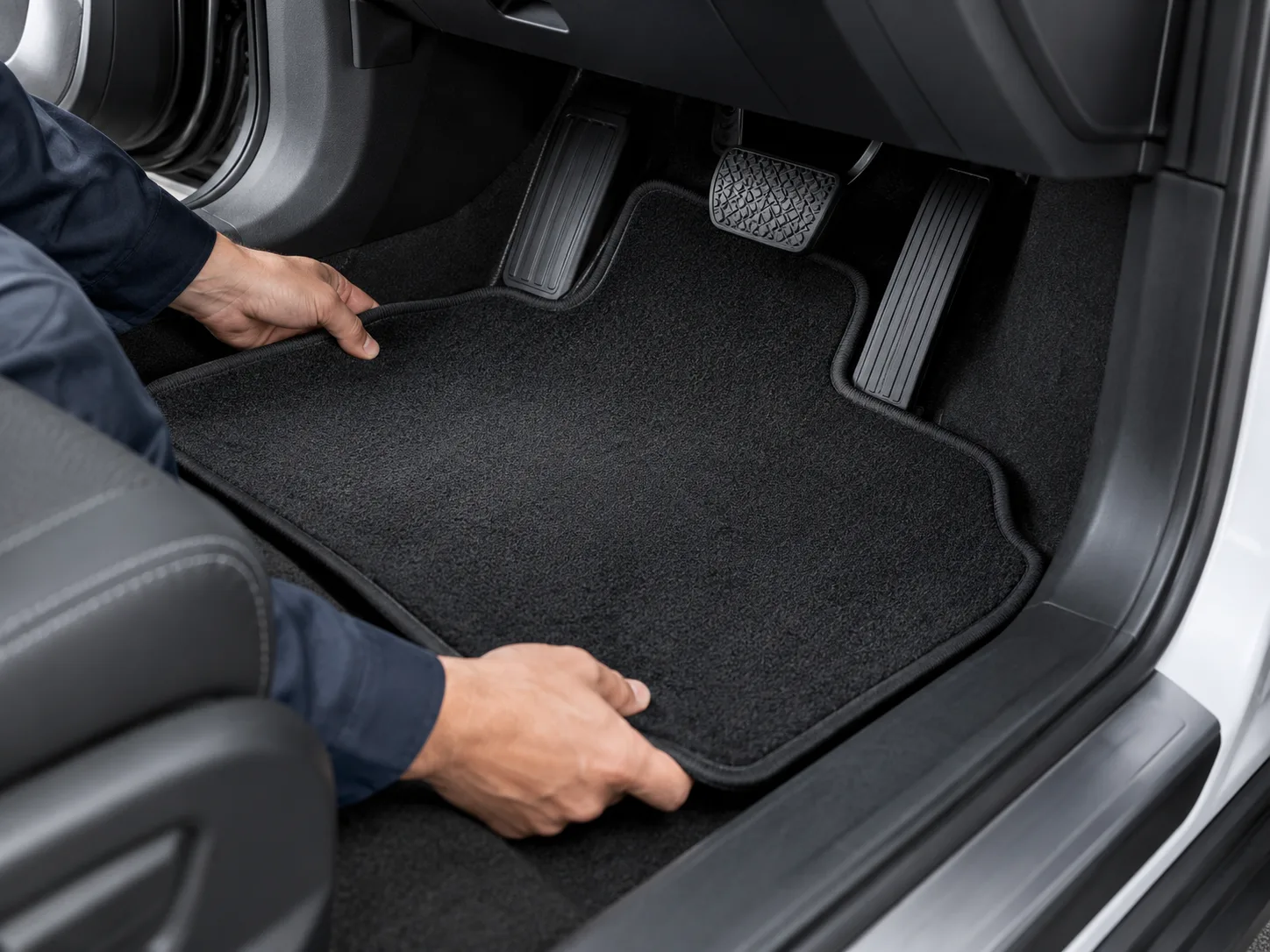
Build the fitment record from make, model, year or production period, market, left- or right-hand drive, body style, trim, seating layout, and any known interior changes. Use an actual vehicle for sample approval when practical. Remove an existing removable mat before fitting the new one, follow the vehicle and mat instructions, engage the correct retention points, and check pedal and seat operation while stationary. Do not approve a driver-side product from photos alone.
For a wholesale program, record exactly which variant was checked. “Fits Model Y” is too broad if the product has only been evaluated in one production configuration. Ask whether the supplier's available tooling covers the intended market, model year, and driving side; request written confirmation for untested variants instead of extending a fitment claim by inference.
What should a buyer ask the factory to test?
Start by asking what is already available for the specific offered item. Do not paste a long generic standards list into an RFQ and assume every method fits the construction. Agree on material and finished-part checks that correspond to your claim, market, and risk.
Hardness can help monitor material consistency. For elastomeric materials, ASTM D2240 describes durometer hardness measurement, but the test type, specimen, conditioning, and target range must be specified. A single hardness number does not predict whether the installed mat will stay flat or feel comfortable. Tensile, tear, abrasion, heat aging, low-temperature flexibility, and exposure to liquids may be relevant, but select methods and acceptance limits with a qualified lab or engineer.
Finished-part inspection is equally important. Ask for a dimensional drawing or check points, mass range, visual-defect criteria, color reference, texture approval, and sample photos. Review edge height, trimming, warpage, retention-hole position, set completeness, and label accuracy. Use the approved sample as a physical reference, but document its revision and any permitted production tolerance. If the product is packed folded or nested, inspect its shape after the specified storage and recovery conditions.
Odor deserves its own agreement. “Odorless” is an absolute claim that is hard to support. Instead, define an assessment method, conditioning period, sampling plan, and acceptance language appropriate to the market. Request third-party reports if a retailer or regulator requires them, and check that each report identifies the tested material or finished part, date, method, and supplier.
A short sample-review sequence
- Match the sample label to the quotation, material description, vehicle variant, and revision.
- Inspect both faces and the perimeter under normal light; record defects with scale photos.
- Place the mat in the exact vehicle without forcing it; check retention, pedal clearance, doors, footrest, console, and seat travel.
- Clean an everyday soil sample using the proposed care instructions; check grooves and drying.
- Compare packaging, set count, barcode, carton label, and recovery after transport-style packing.
- Record pass, fail, or change needed for each point and require a revised sample where a change affects fit or safety.
The shorter TPE sample-review checklist can be used as a companion record during an initial supplier conversation.
Send Your Requirements: If you are comparing TPE, rubber, or PVC programs, send your target vehicle list, destination market, estimated quantity, coverage, and price tier to HZHZMOLD's contact page. Ask for the available TPE options and the specific product documents that can be shared for your project.
How to compare quotations on a landed-cost basis
Request quotes using the same specification and Incoterm. For each material option, record the unit price and currency, tooling or development cost, sample cost, logo and packaging charges, minimum order quantity, production lead-time estimate, cartons per set, carton dimensions and gross weight, inspection arrangement, and destination. Customs duties and freight should be calculated by your logistics partners against the actual tariff classification and shipment details.
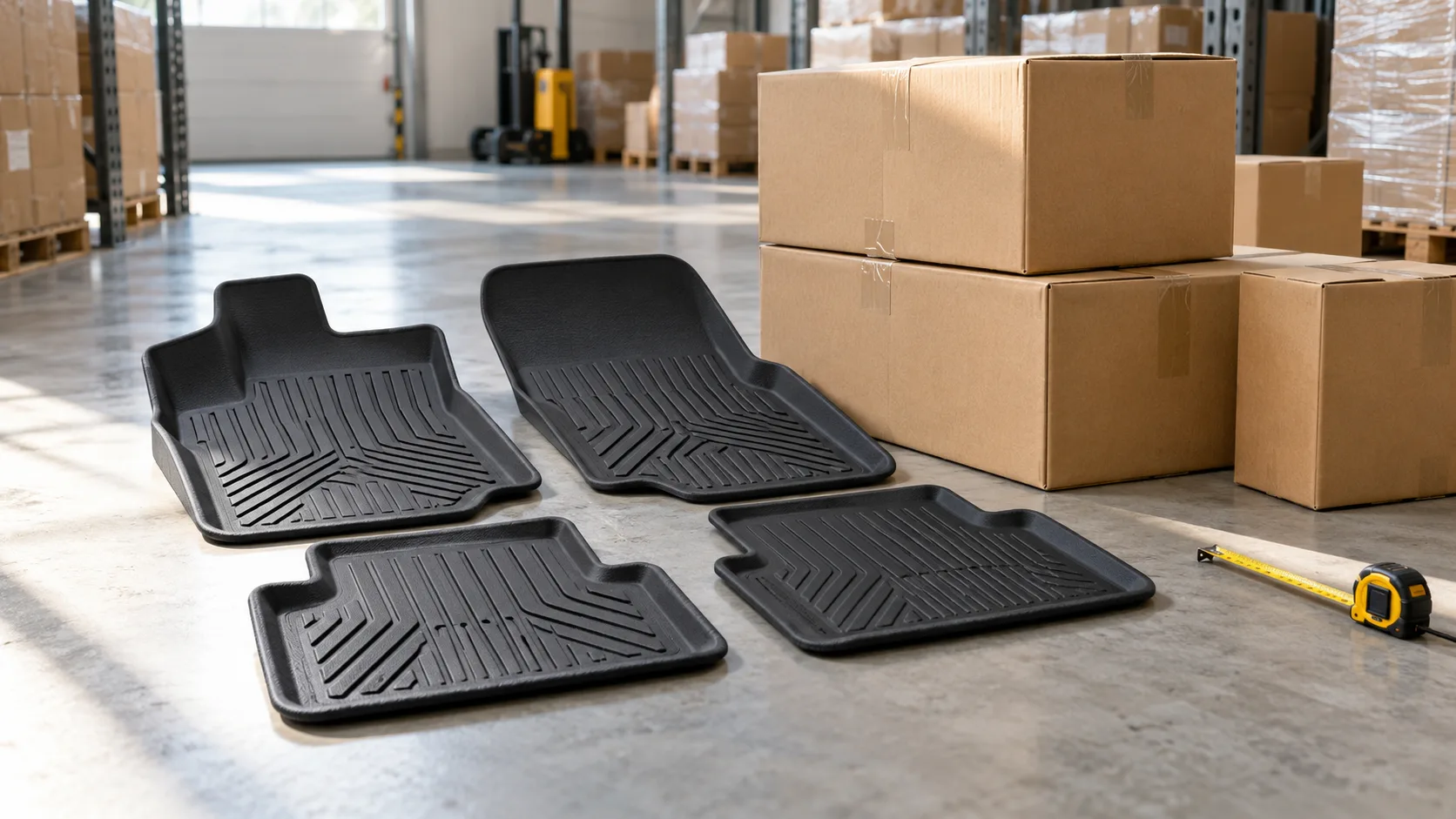
Check what happens if the vehicle variant changes during development. Is a different mold required? Does a revised clip or trim change the unit price? Is the quoted MOQ per fitment, color, logo, or purchase order? A supplier's broad MOQ headline may not apply to a mixed-model first order. Treat all unconfirmed figures as project variables rather than publishing a fixed “factory MOQ” or lead-time promise.
For private-label distribution, include the work after arrival. Does the label identify a precise model-year range? Can a warehouse pick the correct left-hand-drive and right-hand-drive SKU? Will the carton survive the chosen distribution channel? Can customer service trace a reported fit problem to a batch and sample revision? Those factors can outweigh a small material-price difference.
Which material fits which buying scenario?
A distributor building a premium vehicle-specific line may start with TPE samples because molded coverage and cleanable channels fit that positioning. The decision still depends on real-vehicle fit, finished-part quality, production consistency, and landed cost. A fleet buyer may value a robust rubber construction and straightforward replacement more than a deep custom contour. A price-sensitive universal range may consider PVC or another construction, provided the product passes its own use and market requirements.
These are starting hypotheses, not rules. If a supplier offers two TPE grades or a TPE and rubber design, run them through the same comparison sheet. The stronger choice is the product that meets the agreed brief with documented evidence and a workable supply program.
FAQ
Is TPE always better than rubber for car floor mats?
No. TPE and rubber each cover many formulations. Compare actual finished samples for fit, retention, cleaning, odor, durability, packaging, and landed cost. The intended vehicle and sales channel determine what “better” means.
Are TPE floor mats automatically recyclable?
TPE is thermoplastic and some grades can be reprocessed, especially as controlled factory scrap. A claim about a finished mat's end-of-life recyclability needs evidence about its composition and the collection and processing options in the target market.
Which material has the least odor?
No material label alone guarantees this. Ask for a finished-part odor assessment, the conditioning method, and a sample from the proposed production formulation. Avoid “odorless” unless the claim has a defensible definition and evidence.
Is a thicker mat always more durable?
No. Thickness affects mass and feel, but wear also depends on compound, geometry, heel-area design, and manufacturing quality. Compare an agreed wear or abrasion method and inspect the finished part after use or testing.
What information should go into a material RFQ?
Include the vehicle and market list, driving side, set contents, target price tier, quantity by SKU, material preferences, required documents, logo and packaging needs, shipment destination, and your acceptance criteria. Ask which details the supplier needs to confirm before quoting.
Conclusion
The right wholesale floor mat material is the one that supports a verified vehicle fit, acceptable finished-part performance, compliant claims, and a sustainable commercial plan. TPE, rubber, and PVC can all serve legitimate programs; none should be bought on a generic material slogan. Define the product, compare equivalent samples, document the evidence, and keep the approved specification tied to every production order.
Get a Quote: Share your vehicle list, target market, set configuration, estimated quantity, and packaging brief through the HZHZMOLD inquiry form. Request product-specific fitment and material details before deciding which option to source.