Introduction
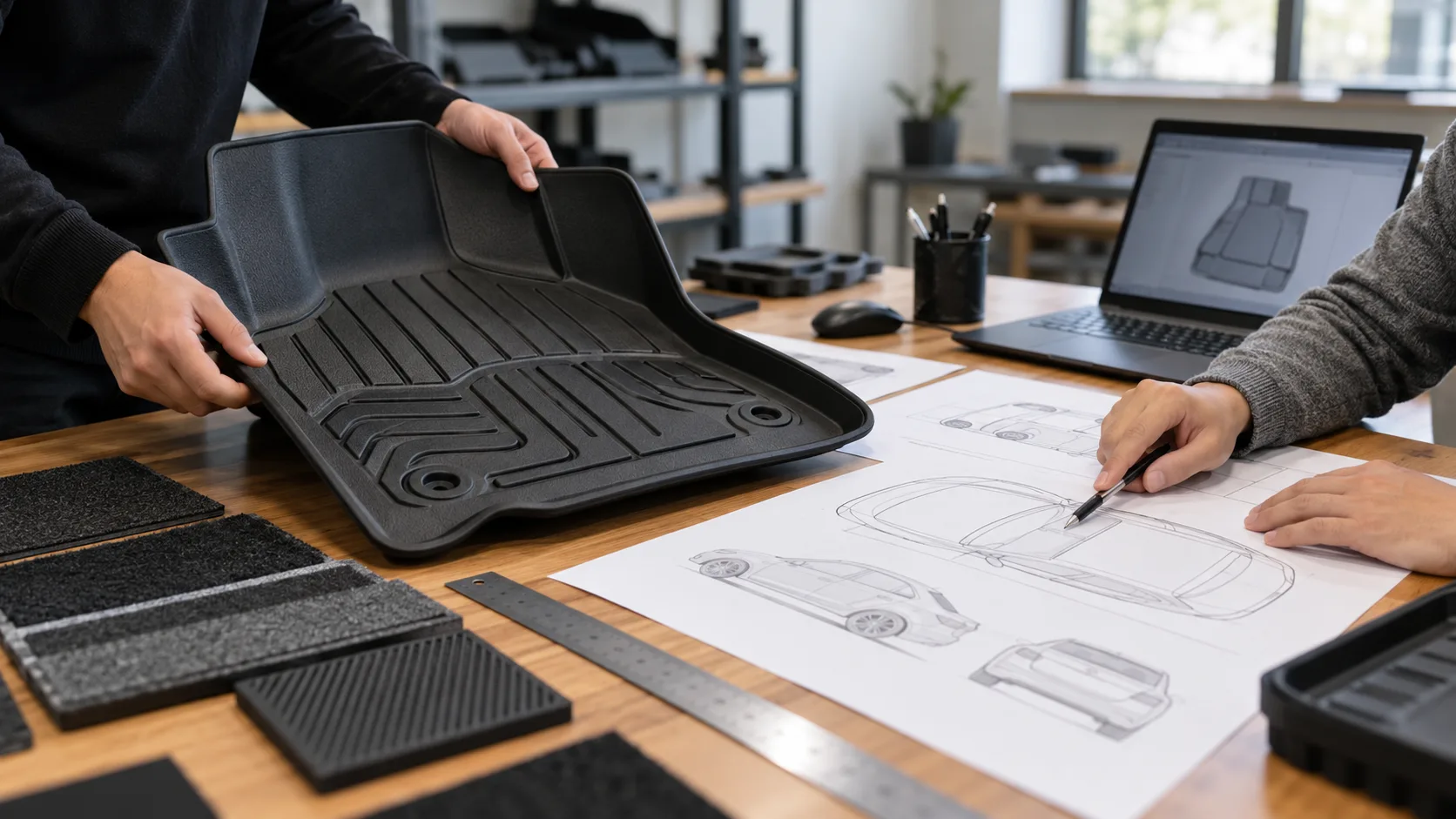
An OEM floor mat inquiry can look simple: send a vehicle name, choose a material, add a logo, and request a price. In practice, the costly mistakes usually happen between those steps. A model name may cover different driving sides and cabin layouts. A good-looking sample may not represent the packed production item. A quotation may omit tooling, clips, artwork, or carton requirements. The product can then reach the warehouse with fitment or labeling problems that are difficult to resolve.
This article gives importers, distributors, aftermarket brands, and project buyers a sequence for specifying a custom-fit floor mat program. It covers the vehicle brief, mold and material questions, sample approval, production controls, shipment inspection, and purchase order handoff. It is written as a working checklist that a buyer can adapt with a supplier; actual methods, tolerances, lead times, and documentation must be agreed for the individual SKU.
Quick answer: A reliable OEM floor mat purchase starts with a vehicle-by-vehicle fitment matrix and a written product specification. Approve a physical sample in the intended vehicle, define measurable production acceptance criteria, and inspect labeled sets and cartons against the approved revision before shipment. Request a quote only after the supplier knows the exact variants, quantities, branding, and destination.
1. Define the commercial program before sending CAD files
The first document should describe the buying goal. State whether the product is for an automotive accessory brand, dealership program, marketplace listing, fleet, or retailer. Record the countries of sale, planned launch date, target wholesale and retail price bands, estimated quantities, and packaging channel. A premium deep-tray liner and an economy universal mat need different tooling and quality decisions even if both are called “car floor mats.”
Decide which parts you intend to sell: two front pieces, a rear one-piece tray, separate rear pieces, cargo liner, or a complete bundle. If the floor mat set and cargo liner have separate barcodes, put that in the brief. Define color, logo location, texture, edge style, clip or retention approach, and packing format as requested features rather than assuming every option is already available.
The commercial brief should also state what you need the supplier to confirm: existing mold availability, minimum order quantity per variant, development charges, sample cost, lead-time estimate, material documents, inspections, carton data, and delivery term. Do not present an early target price as a final specification. A useful RFQ gives enough detail for a comparable quote while leaving room to discuss feasible alternatives.
2. Build a vehicle fitment matrix
One line per actual vehicle variant is more useful than a long list of marketing model names. Include make, model, model or production year, body style, country or region, left- or right-hand drive, seating rows, trim or battery/floor variation if relevant, and the intended set contents. Add a column for the exact vehicle used for sample testing and a column for approval status.
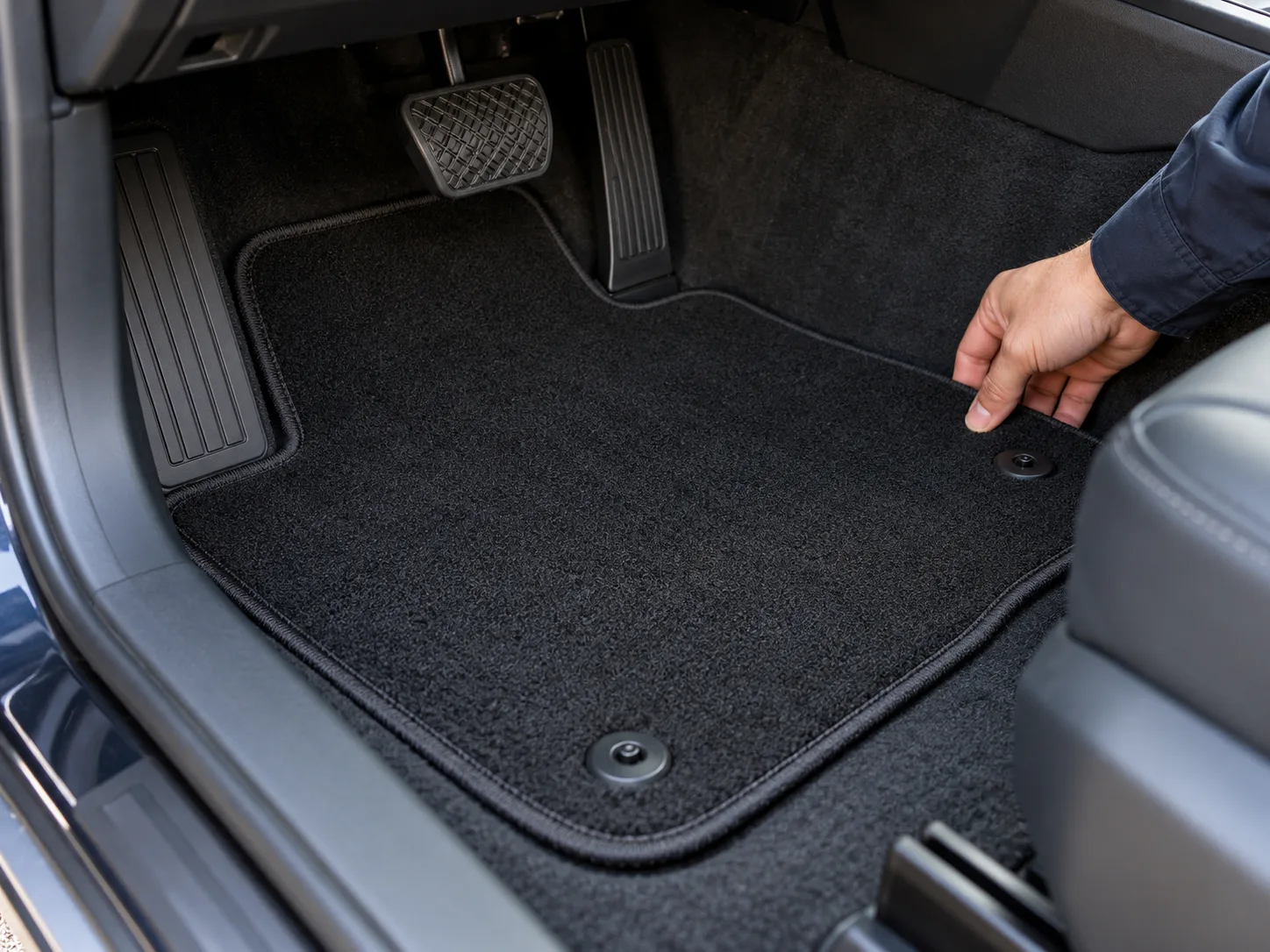
For example, “2024 SUV, right-hand drive, seven seats, Australian market” is a better starting point than “SUV 2024.” If a supplier says an existing mold covers multiple years, ask for the documented range and exceptions. Changes to a center console, floor anchor, seat rail, cargo-floor height, or pedal box can matter even when the body name remains the same.
Request clear footwell photographs if a physical vehicle is not immediately available, but do not treat photographs as a full substitute for an installed sample check. Record left and right front footwells, anchor posts, pedal area, rear tunnel, seat-track extremes, and cargo-floor positions. The driver-side mat deserves specific attention: incorrectly installed mats can interfere with pedals, as NHTSA warns. Any claim about vehicle compatibility should be confined to variants actually reviewed or otherwise documented.
A simple matrix structure
| Field | Why the buyer needs it |
|---|---|
| Vehicle ID and market | Separates lookalike models sold in different regions |
| Model/production year range | Controls mid-cycle interior changes |
| LHD/RHD | Changes driver-side geometry and retention review |
| Seats and cargo layout | Determines rear and cargo piece coverage |
| Mat set contents | Prevents quote and packing-list mismatch |
| Mold/reference revision | Connects approval to production tooling |
| Fit-test vehicle and date | Shows what was physically checked |
| Status and open issues | Stops an unapproved variant entering an order |
The matrix becomes the shared language for sales, engineering, purchasing, quality, warehouse, and customer service. Keep it versioned. If an item changes from front-only to a three-piece set, update the SKU, label, packing instruction, and quote together.
For a first pass at the vehicle data, use the site's shorter floor-mat fitment checklist. This article expands it into a purchase and production record.
3. Ask what “OEM/ODM” means in this quotation
Suppliers use OEM and ODM in different ways. Some offer private-label packaging on an existing mold. Others can modify a surface texture or develop tooling for a new vehicle. Ask which parts of the proposal are already proven, which are adaptations, and which require new design and validation. The answer affects cost, timing, ownership of tooling, and the level of review required.
For an existing mold, request the mold reference, supported variants, representative installed photos, and sample availability. For a new mold, ask who supplies vehicle scan data or measurements, who owns the design files and tool, how revisions are charged, how many sample rounds are included, and how the tool will be stored and maintained. Clarify whether a logo insert can be changed without rebuilding a major tool surface.
Branding must be reviewed in the actual product context. A logo that looks correct in a vector file may sit where shoes abrade it or where a molded channel distorts it. Request a physical logo sample, color target, placement drawing, and packaging artwork proof. Keep brand claims, vehicle compatibility text, and regulatory labels under the buyer's approval rather than allowing unreviewed carton copy into production.
4. Specify the material and the finished mat separately
Material properties do not equal finished-product performance. A TPE material data sheet describes a compound under defined test conditions; it does not prove that a large molded mat stays flat after packing or fits a vehicle. Ask for the proposed material family and grade or an approved property window, then define the visible and functional attributes of the completed part.
The finished-part specification can include approved color and texture, nominal mass or thickness at agreed points, edge profile, channel and drainage geometry, retention features, dimensional check points, warpage limit, acceptable cosmetic marks, and set completeness. Use a sample ID and revision number. If a measurement is critical, state the tool, conditioning, measurement location, and tolerance rather than writing “accurate dimensions.”
Depending on the market and claimed features, a buyer may ask about hardness, tensile properties, tear, abrasion, heat aging, low-temperature flexibility, odor, and restricted substances. ASTM D2240 is one recognized method for elastomeric hardness, but method selection and acceptance limits belong to the specific product and lab plan. Do not publish a temperature range, chemical-resistance claim, recycled-content percentage, or certification until it is linked to the actual offered item and a current report.
This distinction improves trust. “We can discuss material and test documentation for your selected SKU” is more useful than an unsourced claim that every mat is certified for every region.
5. Approve an installed sample, not just a tabletop photo
Ask for a labeled physical set that represents the proposed production construction. Before fit testing, compare it with the drawing, quote, and packaging brief. Inspect all pieces under consistent lighting. Record the edge shape, texture, trimming, attachment details, logo, and any cosmetic concerns with dated photographs. If the sample is a prototype made by a different process, identify that limitation and require a production-intent sample later.
Install the sample in the exact vehicle variant. Remove incompatible old mats and follow the vehicle manufacturer's installation instructions. Check that retention features engage, the mat lies correctly without buckling, and there is no pedal interference through full travel. Move seats through their normal range while the vehicle is stationary. Close doors, test the footrest area, and verify rear-seat or cargo-floor adjustments relevant to the set. Document what was physically checked and what remains unverified.
Next, review use and care. Put ordinary dry debris and a controlled small spill in the intended collection areas, then clean the mat as the proposed care instructions recommend. This is a practical user-experience check, not a laboratory performance claim. If the raised edge is interrupted by a clip opening or design feature, describe that accurately in retail copy instead of promising “100% waterproof containment.”
If a fit issue appears, send a change request with the variant, sample ID, location, photos, measurement, and expected correction. Ask the supplier whether the change affects the tool, neighboring vehicle variants, or price. Do not approve mass production based on a promise to “fix it in production” when the change affects safety or fit.
See the companion TPE floor-mat sample review for a shorter inspection handout and the TPE product overview for the currently presented product family.
Send Your Requirements: Have a vehicle program in mind? Send the fitment matrix, target market, set configuration, estimated order volume, logo and packaging brief to HZHZMOLD. Ask which designs can be sampled and which details still need confirmation.
6. Convert the sample into a production control plan
The approved sample is a reference, but production needs written limits. Agree on incoming material identity, in-process checks, finished-part checks, and records. A control plan might define which dimensions are measured, how often, how samples are selected, how defects are classified, and who has authority to stop or release a batch. It should also identify the approved material and tool revision so a substitution cannot happen silently.
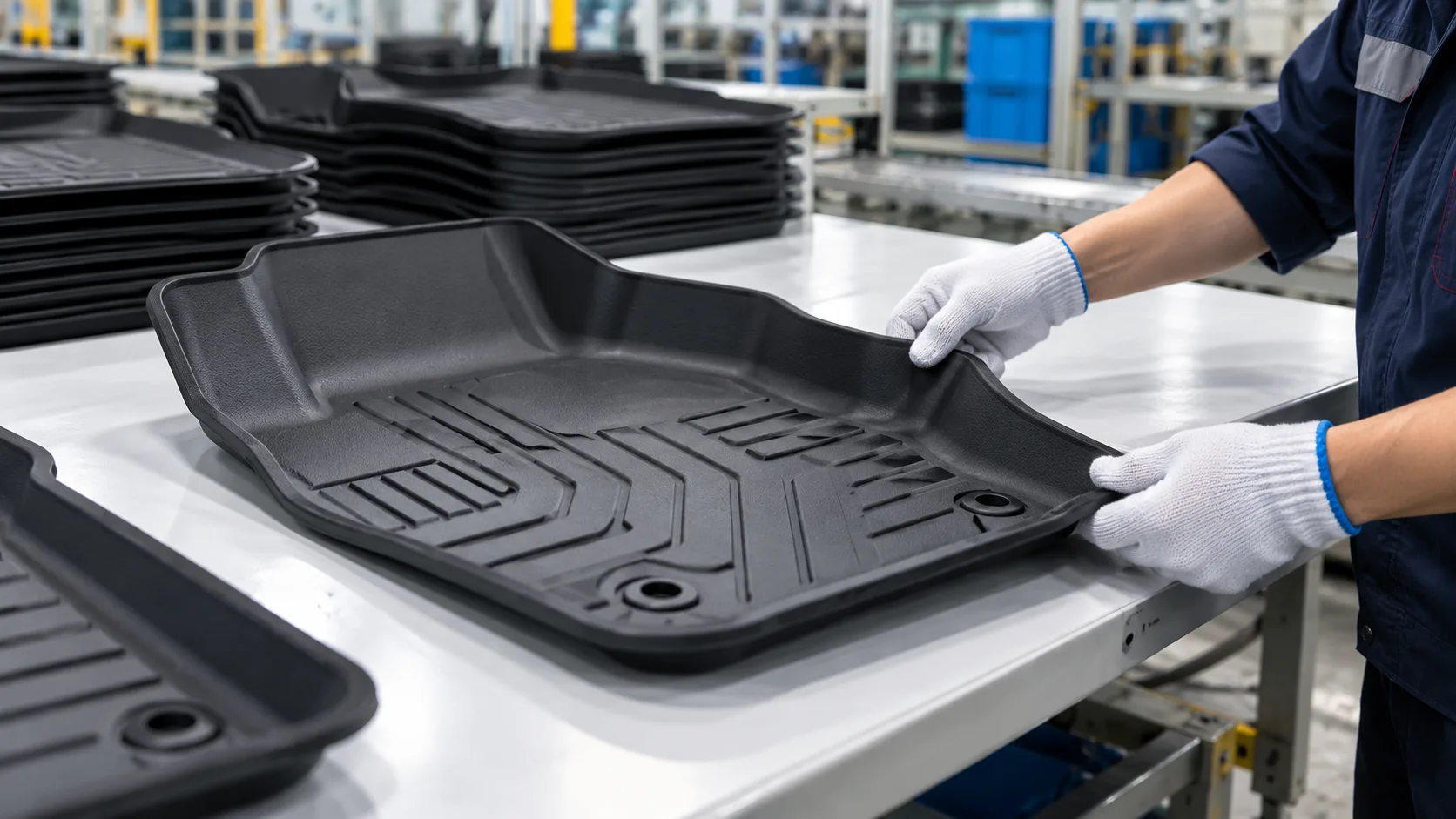
For molded mats, potential visual issues include short fill, flash, uneven texture, color variation, marks, trimming errors, distorted lips, and retention-hole mismatch. Some are cosmetic; others affect fit or use. Decide the classification in advance. A photo library of accepted and rejected examples often prevents disputes more effectively than vague language such as “good workmanship.”
Set packaging checks alongside product checks. Confirm front and rear pieces are grouped correctly, left- and right-hand-drive labels cannot be confused, installation instructions match the product, and cartons identify the SKU, quantity, lot or production reference, and destination requirements. A perfect mat in the wrong labeled carton is still a failed order for a distributor.
7. Prepare the shipment inspection around actual risks
An inspection should compare a defined sample of production units with the approved specification and purchase order. The inspection arrangement can be performed by the supplier, buyer, or independent service; the scope and sampling method should be agreed before production. Do not assume a generic “QC passed” photo album is equivalent to a shipment-release report.
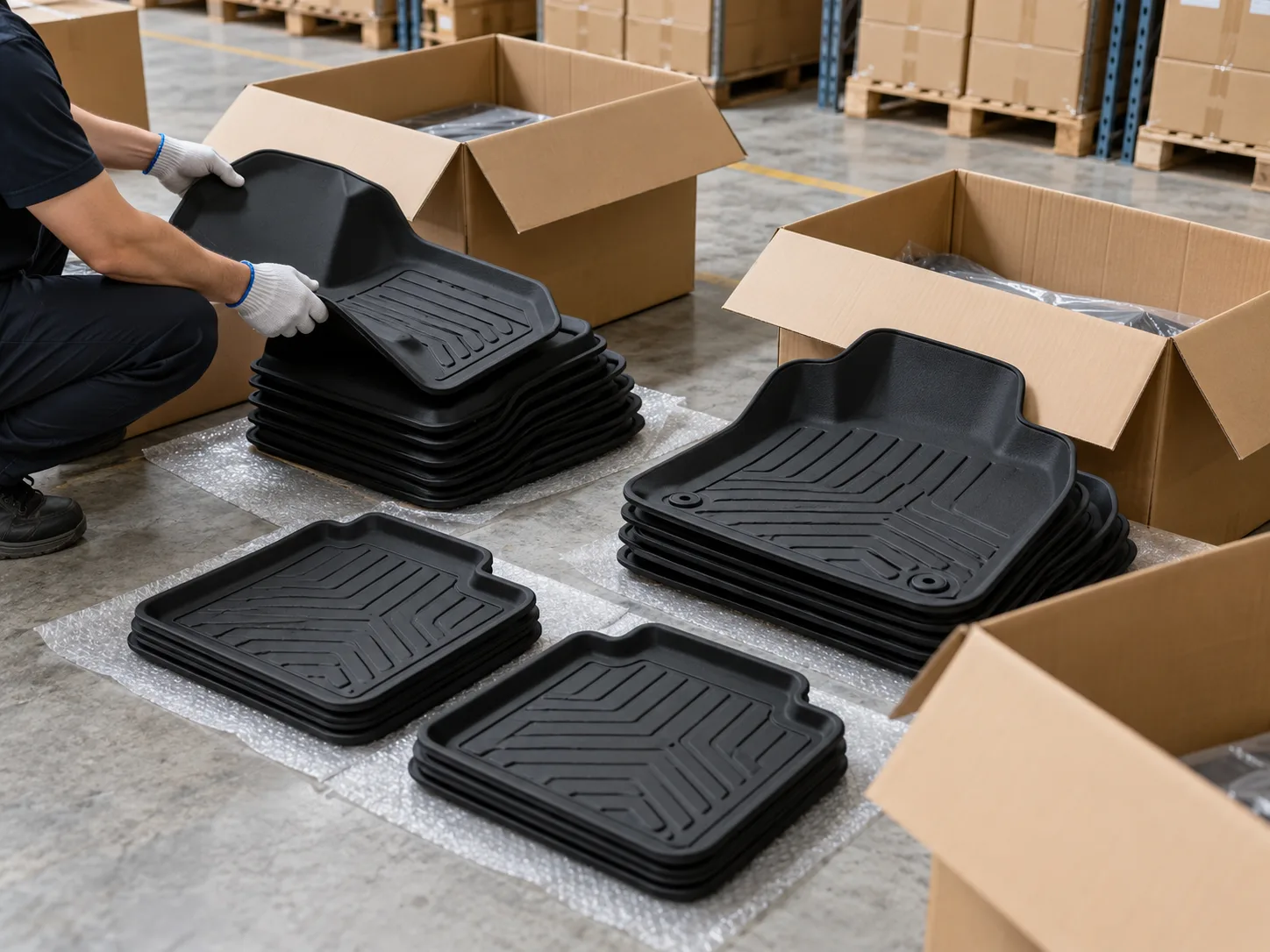
Ask the inspector to identify the order number, product and mold revisions, sample size, carton count, checked SKUs, inspection date, findings, photos, and disposition of any defect. High-risk checks are often set completeness, visible construction, critical dimensions or fit-related features, label accuracy, barcode scan, carton count, and packing method. If the contract calls for laboratory testing, confirm the lab sample's traceability to the production batch.
For a mixed-model export order, request a carton-by-carton or SKU-by-carton packing list. Compare it with the purchase order and physical labels before dispatch. Check gross weight and dimensions against the agreed packing plan and notify the freight partner if they change. Separate a factory-release decision from a shipping-booking decision: a booked vessel is not a reason to waive an unresolved fit or labeling issue.
The site's export packaging primer gives a concise companion checklist for label and carton decisions.
A shipment-release checklist
- Purchase order and approved specification carry matching SKU and revision IDs.
- Required sample approvals and material documents are filed for each SKU.
- Product counts match labels, inner packs, outer cartons, and packing list.
- Critical fit-related features and visual criteria have inspection results.
- Carton dimensions, gross weights, handling marks, and barcodes are verified.
- Open nonconformities have a written disposition and, where needed, a reinspection.
- Commercial invoice, packing list, and delivery terms match the shipment plan.
The exact documents vary by destination and contract. Ask your customs broker and freight provider to confirm the applicable shipping and import requirements; a blog checklist cannot substitute for their shipment-specific review.
8. Compare suppliers by evidence and total program cost
Use the same RFQ for each supplier. Compare the ability to identify the actual fitment, quality of sample and documents, tooling plan, revision process, packaging control, quote completeness, response to defects, and landed cost. A low unit quote that excludes mold fees, retention parts, retail labels, or inspection can be more expensive once the order is ready to ship.
Request a realistic schedule with separate milestones: technical review, sample preparation, sample shipment, buyer testing, revision, preproduction approval, bulk production, inspection, and dispatch. Dates depend on tooling and order complexity. An attractive “seven-day sample” headline should not be used as your project schedule unless the supplier confirms it for the selected SKU and mold.
Ask how repeat orders are controlled. Will the same tool and compound be used? How is a change proposed and approved? Can a complaint be traced to a production lot and carton? What records are retained? A dependable repeat-order process matters more to a growing distributor than a polished first quotation.
FAQ
What should I send in the first OEM floor mat inquiry?
Send the vehicle matrix, target markets and driving sides, requested set contents, material preference, branding and packaging brief, estimated quantity by SKU, destination, and desired timing. Identify open questions; the supplier can then state what it can verify.
Does an existing mold eliminate sample testing?
No. An existing tool may reduce development work, but the proposed part still needs review for your vehicle variant, finish, set contents, and packaging. Ask which vehicle and revision were previously checked.
Can I approve fitment from photos or a 3D rendering?
Photos and renderings help screen a proposal. They cannot establish pedal clearance, retention, seat travel, or exact edge behavior. Use a physical sample in the intended vehicle for final approval wherever feasible.
Which factory tests are mandatory?
There is no universal test list that fits every floor mat and market. Select tests from your product claims, retailer rules, destination requirements, and technical risks. Specify method, sample, acceptance limit, and report traceability before ordering.
What should a preshipment inspection include?
It should reference the approved product and packaging revisions, identify sampled SKUs and cartons, record product and label checks, document defects, and provide a clear release or corrective-action decision. Tailor the plan to the order's risk.
Conclusion
An OEM floor mat program succeeds when a buyer can trace one vehicle variant from initial brief to approved installed sample, production specification, carton label, and shipment report. That chain of evidence reduces ambiguous claims and makes defects easier to resolve. The fastest useful next step is to send a precise fitment matrix and ask the supplier to identify what is already available, what requires development, and what still needs testing.
Get a Quote: Share your vehicle variants, target market, quantities, material and design requirements, and packaging plan through the HZHZMOLD contact form. Request a project-specific fitment, sample, and quotation discussion.